Tuesday, April 19, 2016

Simulation Games: Fact or Fiction?

In Fiction, Juul discusses the fictional world: what comprises it, how its classified, how its interpreted, and more. His main argument is that "all fiction worlds are incomplete," and that " no fiction exists that completely specifies all aspects of a fictional world." Juul claims that "the reader must work in order to imagine a fictional world," and consequently "different readers and game players will imagine a fictional world differently." While this may be true, I have to wonder what Juul would say about Simulation games.

Some games use the "simulation" classification as a humor tactic. Surgeon Simulator, a popular hospital surgery simulation game, emulates open heart surgery with the player as the surgeon. The
player is given finicky controls and an unrealistic time limit, and is scored based on the amount of blood lost by the patient during the surgery, with of course the smallest amount of blood loss yielding the highest score. While Surgeon Simulator classifies itself as a simulation game, it does not simulate a realistic surgery. It, in fact, uses the concept of simulation to play off of its purposefully radical design, telling an unspoken joke about the complexities of surgery and the consequences of lay-men performing these surgeries.
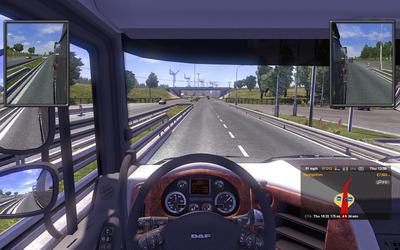
These types of simulation games aside, I would be interested to hear Juul's commentary on the fiction Euro Truck Simulator 2, where the player sits in the driver seat of a large truck and is able to drive to an from a host of major cities in Europe. Euro Truck Simulator 2 attempts to provide an ultra realistic truck driving experience, and subsequently gives the player turn-for-turn accurate roads to interact with.
worlds created by the other type of Simulation game, the type that seeks to perfectly emulate the idea or concept that it is simulating. These games actively attempt to avoid creating fiction worlds, and much of their selling points involve the realism that they can provide. One example is the truck driving simulator

These types of games, including Euro Truck Simulator 2, could just be seen as games that create their own, intensely realistic, fiction worlds, but because Euro Truck Simulator 2 intends to offer as realistic an experience as possible and in no way seeks to provide fiction, it can also be argued that it does not create a fiction world at all and that it simply creates an incomplete representation or reference to the non-fiction world.

I imagine that Juul would agree with the first case, while many others might agree with the second case. There exist many simulation games that are used for job training, for education purposes, and more. If Juul were to agree with the first case, that even simulation games that intend to not provide fiction create fiction worlds, I would wonder what this would mean for games used for training that I just described, do these games also create fiction worlds? And if they do, is it enough to train in a fiction world for a performance in the real world?

Monday, April 18, 2016

Hidden Political Propaganda in Video Games

After reading “From the Green Berets to America’s Army: Video Games as a Vehicle for Political Propaganda” by Aaron Delwiche, it became apparent that most video games have some sort of political propaganda behind them. Games such as “Special Forces and America’s Army are consciously designed to foster support for the military objectives of their creators, while recruiting youth to pick up arms in support of those goals” (Delwiche 92). The Special Forces and America’s Army games present war in an exciting manner for the player, in the hope they will be enticed to join the army from a relatively early age.

Political Propaganda in video games doesn’t end here. There are various other genres in the video game industry that also have a political background. If Delwiche is going to go as far as saying that a shooting game is a tool for military recruitment, would it be so far fetched to say that sport games are tools for participation. The government, especially in the UK, has always been trying to tackle obesity and low exercise levels. FIFA, and other sport orientated video games can be a tool to promote exercise and thus government objectives; without publicly enforcing it.

Video games can also be used to promote gender balance in sport. FIFA 16 has been used as a catalyst for increased female participation, aiding in the governments objectives for the youthful and adult population. On the cover of FIFA 16 there is Alex Morgan. In the game players can play as female national teams. Millions of dollars have gone into the advancement of FIFA and its visual quality, so much so that it encourages players to play soccer afterwards. As a result of the persuasive coverage of female soccer in the gaming industry, female soccer is on the rise.

Other video games, such as Call of Duty can often set misleading views upon young children. Call of Duty is a very popular game among youths, which is set upon the values of terrorism and mass killing. It can be thought that the production of so many shooting games makes killing acceptable, misleading people to thinking war is acceptable. 

The Quest for Bush video game is a shooting game in which American soldiers occupy 6 levels. Terrorists storm the building, and the aim is to complete all 6 levels and get to George Bush (the president). This video game was released by the Global Islamic Media Front which is an Al-Qaeda ran organization. It was used as a catalyst for recruitment, and a medium for which terrorist organizations could fictionally present their aims. By allowing young people to play this, it was thought, in 2006, that it would perhaps reconfigure children’s minds. The game tried to promote hatred towards the United States in the hope that players would eventually gain more interest in terrorist organizations, strengthening their standpoint. From reading Aaron Delwiche’s article, it can be highlighted that many video games contain political propaganda, with some hidden messages being stronger than others.


Grand Theft Auto: Stealing Cars... and You

In the article From the Green Berets to America's army: video games as a vehicle for political propaganda, Aaron Delwiche discusses video games influencing those who play them. He identifies and describes “the four traits of video games that might function as mechanisms for influencing attitudes”, and these four traits are described as “the four I’s” (Delwiche 92).

The first one, immersion, has to do with the game engaging and dominating the senses of the user. The user is forced to utilize his or her senses while playing the game and as a result, engages heavily in the game. The user can’t just mindlessly play it as if he or she were watching a boring television show. He or she has to be apart of it.

This brings us to the second one, intense engagement, where the user’s “flow state”, a term characterized as his or her “focused concentration”, “time distortion”, or “sense of control” over actions, are induced because the game offers “clear objectives, precise feedback, immersive audiovisual material, and content that is dynamically adapted to reflect the user choices” (Delwiche 96). The user is playing a game that creates a world he or she is mentally affected by due to how intelligent it is.

The third trait is identification where the user identifies “bodily” with the game personas and “psychologically” with the “narrative arc” created by the character’s choices (Delwiche 97). The user takes the identity of the fictional game character, putting him or herself into the game.

Last but not least, there is interactivity which has to do with the user making decisions and the game’s AI (Artificial Intelligence) responding with an outcome. The AI of the game displays the outcomes of the user’s decisions very realistically, allowing him or her to believe they are contributing to a huge alternate world.

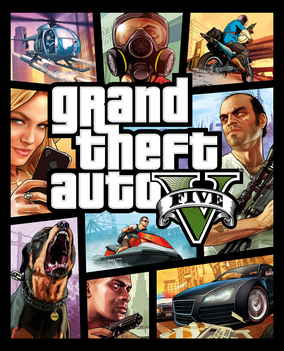
A game that utilizes these traits that pull the user in would be Grand Theft Auto V where the user can take on a character and play missions involving criminal activity. This game, unlike many of its predecessors, is incredibly realistic in terms of setting and has an AI that returns incredibly accurate outcomes. For instance, if one were to point a gun at any civilian, such civilian would run away instantly. When I played this game and tried to steal an ambulance, I was beaten up by the medics until I pulled a gun out. This is an excellent example of interactivity.

Identification is also involved when the user takes on the personality of the character and has direct influence on what that character does as well as what happens story-wise as a result of the decisions made on behalf of that character. When I played as the character Michael and killed someone in an area of witnesses, the witnesses ran and the police, notified by some civilian, went after my character.
The game also forces its users to engage intensely by requiring a lot of necessary moves for every significant course of action. When I had to chase and attack the tennis instructor having an affair with my character’s wife, I was forced to be heavily focused as if I was actually doing so in real life because I was so immersed into the game by the task, for I knew that if I was passive in my pursuit, I would have gone the wrong direction and lost my target.

Delwiche's concepts show and my experience with Grand Theft Auto V truly show how much video games drag in and engage their users, for the four concepts by Delwiche and their power are clearly present in games like the one I played. This game did not change my personality in reality, but should it be in the hands of someone easily manipulated by fantasy, it could be dangerous. Therefore, this game should only be played by people of mature ages.

A Fictional World

One of the only video games I know how to play is the game Mario Kart. Mario Kart, I would say, is a gender neutral game, whereas some games like Grand Theft Auto or Call of Duty are more drawn to the male gender.

Mario Kart is a series of go-kart style racing video games developed and published by Nintendo as a spin-off from its trademark Super Mario series. This is a game full of different fictional characters as well as fictional race tracks. It started off in its original says with the original 8 characters and than continued to grow and add more fictional characters. The game can take place in a city, in a town square, in a mall, in an ice land, or even on a rainbow. The first article we read says this, "Such fictional game worlds, obviously, do not actually exist, they are worlds that the game presents and the player imagines" (121).

Mario Kart is obviously not reality, it is just a reality created for us by the creator and carried on by imagination. The question is...what kind of worlds we find in games and how games cue players into imagining worlds?

Jesper-Juul comes to a conclusion that there are five main types of video games: Abstract games, Iconic games, Incoherent world games, Coherent world games, and staged games. I believe Mario Kart falls under the category of Incoherent world games and this is why.

An incoherent world game is one with a fictional world but where the game can sometimes contradict itself as not being part of the fictional world. IN Mario Kart, we cannot explain why some players can fall off of the edge, or why there are powers that can help (or hurt) you, or why one person has to win each game rather than just playing for fun, or even why we have to chose different characters or different carts to drive; these are all just rules of the game.

Mario Kart cues a player into imagining a fictional world. "Games can do this in a number of different ways: using graphics, sound, text, cut-scnens, the game title, box, or manual, haptic, and rules" (134). Along with this, players use a game control to control the actions in the game. For example in Mario Kart, you can push the stick to the right, making the character go in that direction, or you can press different buttons to make you "press on the gas" or "press on the break" or even release your special powers. All of these things allow the player to interact as the character in their own fictional world, creating and imagining the game as it plays out.

Propaganda in Video Games

Do video games make you more violent? This is the question that researchers have been interested in since the beginning of violent video games. It is the age old question that parents have been asking themselves since the beginning of time. Well not quite, since the beginning of time. In Delwiche's article he delves into not quite this question of "Do video games make you more violent" but rather he looks at manner in which video games present discourse and ideology.


Delwiche's article reminds me of all the Call of Duty games that I played growing up. Also the article reminds me of my time as a child. As a child, I thoroughly enjoyed watching my favorite YouTuber Chris Smoove play a variety of video games ranging from the highly acclaimed professional basketball video game, 2k to watching his call of duty playthroughs. The games focus mainly on killing the other people with guns. However, there are other game modes in which the most important goal instead of killing other people is capturing flags or capturing specific areas in domination.

In Delwiche's article he focuses on case studies in which he dissects multiple different games ranging from Kuma\\War, Take Back Illinois, September 12th. He also focuses on how propaganda plays a role in these games. In these games, there is obviously a hidden agenda or a message that the producer of the games is trying to push. For example, in September 12th you fire cruz missiles off into a village trying to kill terrorists, but you also kill civilians and when civilians die you increase the number of terrorists. The hidden agenda in TakeBack Illinois is to show how hard it is for teachers to actually do their jobs.

Overall, Delwiche does an amazing job of laying out his case for how video games and propaganda are interrelated.


Choices of Character

Super Smash Brothers; Melee is a game that has combined the most popular characters from some of the most popular games created in video game history.  The game pits players against one another in a last man standing fight to the character's death.  The ability to play as any character from an extremely wide selection of games is something that draws players in, allowing them to utilize their favorite aspects of each character.  This week's article discussing fiction discusses how the use of fictional worlds and characters is used in order to get players to enjoy the game, for Super Smash Bros.; Melee, half of this battle is already finished by utilizing the characters from other games.  Along with the fictional worlds that have been developed, the rules governing the game also affect the play.

Image result for super smash brothers meleeSuper Smash Bros. uses a series of growing challenges in order to teach the game rules to the player, the options for characters are limited at first, but as the experience of the player grows they are pitted against characters that they can use later in the game.  After defeating these characters the player are allowed to choose them.  These initial challenges are the ways in which a new player would be able to learn the rules governing the game.  This process of growing into the game is described at the end of the article; Fiction, in the last section, titled Rules and Fiction.  The author describes this as "a two-way process where the fiction of the game cues [the player] into understanding the rules of the game" (Juul).

Image result for super smash brothers meleeThis game takes place in a fictional world, which Juul describes as "derived from possible worlds" (Juul).  The theory of possible worlds is that in some way, shape or form, they could exist if the right chain of events happened in the right way.  This seems pretty far fetched, especially in the case of this game, because of the multiple fictitious worlds that are combined within the game.  

Due to the combination of characters within the game, the existence of all of their original worlds would have to be possible in order to for the player to connect the characters.  In some respects this would be more difficult, however, assuming that fans of all of the characters are playing Super Smash Brothers, they already find the character's worlds to be possible, and therefore find them all functioning together possible as well.

The combination of the characters into one complete world is something that is intriguing for players, and has helped the game become so popular.  The ability of a player to choose a different character each game, perhaps one of their favorites, is a draw. This ability to create change within the fictional world of the game is something that is unique to Super Smash Brothers.